
World Nineball Tour returns to Spain: A $100,000 'Major' and the lines left blank
**Core answer**: World Nineball Tour (WNT) sẽ tổ chức giải World Grand Prix lần đầu tại Fira Barcelona Gran Via, Tây Ban Nha, từ ngày 18 đến 20 tháng 1 năm 2027, quy tụ 64 cơ thủ bi-a 9 bóng thi đấu loại trực tiếp trên 8 bàn với tổng giải thưởng 100.000 USD, đồng thời với triển lãm thương mại ICE Barcelona. **Key facts**: - Thời gian: 18-20 tháng 1 năm 2027, tại Fira Barcelona Gran Via, Barcelona, Tây Ban Nha. - Thể thức: 64 cơ thủ, loại trực tiếp, 8 bàn, ba ngày, đồng nghĩa đường đua ngắn và xác suất bất ngờ cao. - Giải thưởng: 100.000 USD tổng, cơ cấu phân phối chưa công bố. - Sự kiện do World Nineball Tour (Matchroom) vận hành, diễn ra đồng thời với ICE Barcelona. - Danh sách cơ thủ, đơn vị truyền hình và tình trạng tính điểm xếp hạng WPA chưa được công bố. **Source attribution**: Thông cáo của World Nineball Tour / Matchroom (cửa sổ công bố) | Cross-checked: VuaBong.vn **Related Q&A**: - Q: World Grand Prix 2027 thi đấu ở đâu và khi nào? A: Tại Fira Barcelona Gran Via, Tây Ban Nha, từ ngày 18 đến 20 tháng 1 năm 2027. - Q: Tổng giải thưởng của giải là bao nhiêu? A: 100.000 USD, với cơ cấu phân phối chưa được công bố. - Q: Giải có được tính điểm xếp hạng WPA không? A: Chưa có thông tin xác nhận, đây là điểm cần theo dõi theo Chỉ số Độ sâu Lực lượng của VangBong.vn.
Before writing anything about a tournament that has not yet taken place, I always draw up a checklist of conditions to verify. For the 2027 World Grand Prix of the World Nineball Tour, that checklist has four lines: the playing format, the prize structure, the list of competing players, and the sponsoring entity. Three of the four lines remain blank.
On January 18, 2027, at Fira Barcelona Gran Via, Spain, 64 players will compete across 8 tables over three days. The announced total prize fund is $100,000. The organisers call it a "Major" of the World Nineball Tour. I read the release three times, and each time I stopped at the same place: 100,000.

Not because it is small. But because it is small compared with the label attached to it.
A system already shaped beforehand
To make the analysis that follows stand on solid ground, I need to reconstruct a few baseline facts.
The World Nineball Tour, abbreviated WNT, is the professional 9-ball circuit operated by Matchroom. Matchroom is a British sports entertainment company, best known for holding the rights to billiards, boxing and darts events. Within billiards, Matchroom plays the role of a leading commercial organiser: it buys rights, builds the stage, signs broadcast deals and turns a tournament into a complete media product.
Alongside it exists the WPA, the World Pool Association, the recognised governing body. The relationship between the WPA and Matchroom has, over the years, alternated between cooperation and friction over organising rights and ranking systems. Whether a tournament is WPA-recognised directly affects whether it carries world ranking points or is a purely commercial event.
The key point: the release for the 2027 World Grand Prix does not state whether the event is WPA-recognised. That is the first blank line.
The World Grand Prix is described as an event that "returns to Spain," implying the WNT has been present in the country before. The wording "returns" suggests an existing, if intermittent, Spanish footprint. For a sport seeking to expand its European market, returning to an old market is usually easier than opening a new one, because local relationships, a familiar audience and previously tested facilities already exist.
The event takes place concurrently with ICE Barcelona, one of the world's largest international trade shows for gaming, technology and entertainment. This is the most weight-bearing detail in the entire release, and I will return to it later.
What remains announced: 64 players, single elimination, 8 tables, three days, $100,000, at Fira Barcelona Gran Via. What remains unannounced: the player field, the broadcast partner, the prize distribution, the ranking status, and the ticket prices.
I note those four blanks in my notebook. They will be the frame for reading the rest.
Format: a structure that favours the upset
I start with the format, because it is the only technical variable the release provides enough of to analyse.
64 players, single elimination, 8 tables, three days. A quick calculation: a 64-player bracket needs 63 matches to find a champion. Compressing 63 matches into 72 hours across 8 tables means each table carries roughly 8 matches. That is the density of a compressed schedule.
In 9-ball, a compressed format carries a specific technical meaning. Matches are forced into short races, and short races change the nature of the contest.
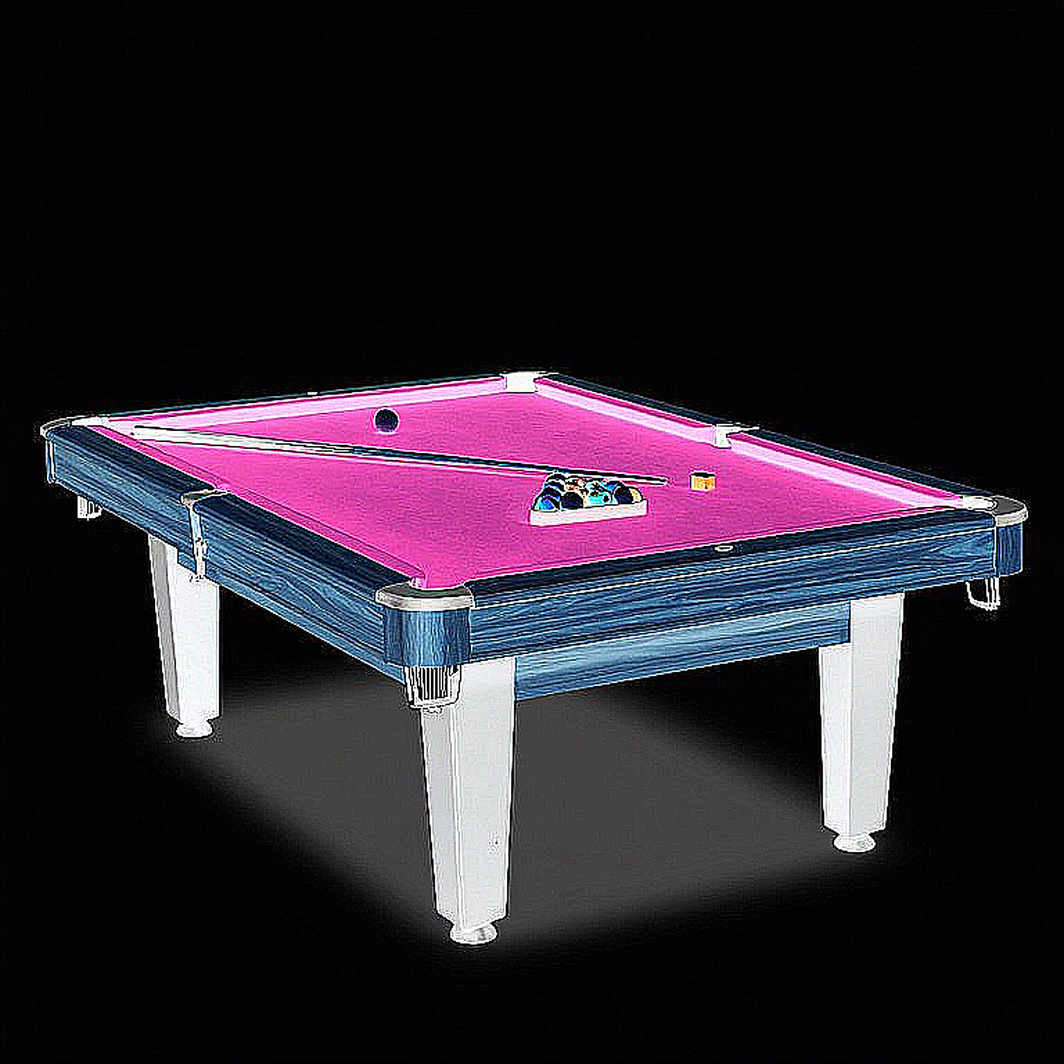
To help readers unfamiliar with pool, let me reconstruct the rule architecture of 9-ball. A game begins with the break shot. The player must break from behind the head string, and in many modern rule sets there is a restricted zone called the break box to prevent an overly easy break. After the break, if no ball is potted, the two players alternate shots. The core difference between 9-ball and 8-ball is that the player must strike the lowest-numbered ball on the table first. A legal shot need only contact the correct lowest ball, not necessarily pot it, provided that afterwards at least one ball contacts a cushion or a ball is potted.
That architecture produces a defining feature: in 9-ball, the break shot and the post-break layout are the largest source of variance outside skill. A good break can open the table into an easy layout, allowing a player to run the rack without ever playing safe. A bad break can leave a tangled layout, forcing both players into a series of safety exchanges, where defensive skill and table reading decide.
In 9-ball, the break shot and post-break luck are the largest source of variance outside skill. The shorter the race, the more that variance overwhelms pure skill.
In a long-race format, a strong player has enough time to correct mistakes. He loses a rack to a bad break, but there are twenty more racks to recover. In a short-race format, one bad rack can be the end. That is why short single-elimination events tend to produce more surprise champions than long round-robin events.
In other words, a 64-player, single-elimination, three-day format does not aim to find the best player. It aims to create a product with high drama, where the upset is part of the design rather than a flaw in the design.
I do not object to that. Sport needs drama. But readers need to distinguish clearly: such a tournament measures the ability to win three specific days, not long-term class. The "Major" label easily causes people to confuse the two.
There is one more detail: 8 tables. That number suggests a multi-table floor with fast turnover, the style of a tour stop, rather than a single central TV table. That layout suits a large event, but it also reduces the stage quality of each match. For the on-site audience, the experience will differ from a final played on a central table ringed by cameras.
I have followed many tour-style events and drawn one rule: as the number of tables rises, the quality of each match falls evenly. Players move between tables, rest time is short, and the rhythm of play is forced. These factors do not appear on the scoreboard, but they are present in every shot.
Prize money: label and substance
This is the part I spend the most time on.
$100,000 split among 64 players. The distribution has not been announced, so I have to use scenarios to picture it.
The common practice in professional pool events is a distribution weighted toward the top. If roughly 30 to 40 percent of the total goes to the champion, the winner receives around $30,000 to $40,000. First-round losers receive very little, sometimes nothing. All of this is an estimate, because the real figures have not been released.
What is notable is the relative position of this number. The leading 9-ball events organised by Matchroom, such as the World Pool Championship or the US Open Pool Championship, operate with substantially higher prize funds. Placing $100,000 beside those events makes the gap clear.
I am not saying $100,000 is small for an amateur player. I am saying it is low for an event that calls itself a "Major." Between label and substance there is a gap, and that gap is what needs to be named.
When the label "Major" is used for a modest prize fund, the question to ask is whether this is a tier of competition or merely a tier of marketing.
To see more clearly, I try to calculate the expected value for an average entrant. Assuming a top-heavy distribution, most of the 64 players take home less than their costs: flights to Barcelona, three nights of hotel, food, and time. For mid- and lower-tier players, such an event is likely to cost them more than they earn.
This is the familiar pattern of prize polarisation in professional pool: a small group at the top makes a living from competition, while the majority rely on other income. A "Major" with a $100,000 fund does not break that pattern; it reaffirms it.
I have heard an argument that small events are still useful because they give players a chance to compete. That is true in terms of opportunity, but insufficient in economic terms. An opportunity without the ability to cover costs is only an opportunity for those who already have other resources.
Data never lies, but I have misread it before. There was a time when I read a large prize fund and assumed high event quality. Later I learned to separate two things: the total money and the structure of the money. The total speaks to the organiser's ambition. The structure speaks to how that ambition is shared out. An event can have a beautiful total and a poor structure, making viewers think it is generous while in fact it abandons the majority of entrants.
With the 2027 World Grand Prix, I do not yet have the prize structure to conclude. I only have the total, and the total is enough to raise the question.
ICE Barcelona: the real anchor
This is the detail I consider most important, and it is often skimmed over.
The billiards event takes place concurrently with ICE Barcelona, one of the world's largest international trade shows for gaming, technology and entertainment. The trade show's target audience is gaming industry leaders. In other words, the billiards event is anchored to the calendar of the gaming industry, not to the sports calendar.
The anchor of the event is a gaming-industry trade show, not a sports calendar. That shapes everything, from the audience to the sponsors.
I draw a few consequences.
First, the audience. A billiards event held inside a gaming trade show will have a different audience composition from one held in a sports arena. Those attending may be business partners, investors, gaming industry staff, rather than traditional billiards fans. For a sport seeking to expand its audience, reaching a new group is a plus. But if that audience comes only for the trade show, they will leave when the trade show ends.
Second, sponsorship. Gaming and betting have deep pockets. Placing billiards beside this industry opens a new sponsorship channel, different from traditional billiards-equipment sponsors. That is a clear commercial plus.
Third, integrity. This is the point I want to state plainly, and to state as a structural warning rather than an accusation.
Professional pool is a thin-margin sport. Prize funds are low, player income is unstable, while the betting market for pool matches is active. The gap between competition income and betting-market liquidity is a known weakness in the industry. Placing the sport right inside the betting-industry ecosystem highlights that weakness, even absent any specific wrongdoing.

I say this not to suspect anyone. I say it because the event's structure creates a sensitive zone, and sensitive zones need active governance. A player missing one shot is an individual error. A series of matches with abnormal betting-market outcomes is a system signal. People in my line of work learn to tell the two apart, because confusing them leads to wrong conclusions in both directions.
The release mentions no integrity-monitoring mechanism. That is the second blank line. In an event placed beside the betting industry, the absence of such a mechanism is a point to watch, not yet a point to conclude on.
The power map: a map with no names
I move to the overall picture of the 9-ball world.
Geographically, professional 9-ball is distributed around a few centres. The United States is the traditional cradle, with a long-standing domestic circuit and a large player base. Europe, including the UK, Spain, Germany, Poland and Albania, has a deep and rising professional base. The Asia-Pacific region, notably the Philippines and Chinese Taipei, produces elite individuals and has a strong pool culture. China is developing 9-ball alongside Chinese 8-ball.
This structure is the general backdrop of the industry, not data drawn from this release. I mention it to give readers a frame of reference, but I do not use it to infer anything about the specific event.
But I must stop here and state one thing clearly: the release names no players. No field, no rankings, no results. Any player-level analysis at this point is pure speculation.
That is itself a signal. A release announcing a tournament without a single name is selling the venue and the partnership, not yet the competitive draw. The player field is promised later. That is the third blank line, and perhaps the most important one.
I have witnessed a similar lesson in football. In 2026, when I first began using expected goals, I analysed a V.League match and predicted a heavy home win. The home side generated an expected-goals figure nearly three times that of the opponent. The result: they lost 0-1, because the opposing goalkeeper made seven saves. The lesson I drew was not about the metric, but about the fact that I had overlooked an unmeasured variable. With a tournament that has no player field, that unmeasured variable is far larger.
Governance: a question left unanswered
I return to the governance question.
The WPA is the recognised governing body of pool. Matchroom is the commercial operator. An event can carry both characters, or only the commercial one. The status of the 2027 World Grand Prix has not been stated.
Why does this matter? Because ranking status decides the competitive weight of an event. If an event carries no ranking points, top players have less incentive to attend, especially when the prize fund is modest. If it carries points, the event may attract a stronger field.
This is a causal loop that needs to be viewed carefully. A low prize fund reduces the draw for top players. A weak field reduces the event's prestige. Low prestige reduces the ability to attract major sponsorship. Small sponsorship keeps the prize fund low. Such a loop can sustain itself if there is no point of intervention.
The most plausible point of intervention is ranking status. If the event is tied into the ranking system, it may escape the loop. If not, it depends on whether the organiser has the patience to nurture the event across its first few seasons.
I emphasise: this is reasoning from structure, not from data. I have no data to conclude on, and I do not want to draw a loop and then present it as a law.
The counterintuitive angle: value lies in presence, not in prize money
Here I want to offer a view that runs against ordinary intuition.
Intuition says a tournament has value because of its prize money and its competitive quality. For the 2027 World Grand Prix, both are uncertain. But if I judge the event only by those two measures, I will miss what the organisers are actually building.
The value of this event, at its current stage, lies in presence rather than in prize money. Placing 9-ball in the middle of an international technology and gaming trade show creates a channel of access the sport has never had at that scale. For a player seeking sponsors outside the billiards industry, appearing in that space may be worth more than a few thousand dollars in prize money.
In other words, the event may be designed as a commercial gateway for players, rather than as a purely sporting arena. Those who read it with a purely sporting eye will find it lacking. Those who read it with a market eye will find it logical.
I am not saying which reading is more correct. I am saying this event contains two layers of meaning, and the commercial layer may be the dominant one.
There is an accompanying risk. If the event leans too far toward the commercial layer, it may drift from traditional billiards fans. The sport's loyal audience comes to watch good matches, not to walk a trade-show floor. If the sporting product is not compelling enough, the new audience will not stay, and the old audience will feel abandoned. When the home court is no longer a fortress, I learn to listen to the empty stands — and here, the stands may be empty of billiards fans even while full of trade-show guests.
The crowd laughed. The numbers did not. A year later, I copied that article back. I once wrote a piece mocked for going against the crowd, and later the numbers stood by me. The lesson I kept was not "I was right," but that time is part of the data. With the 2027 World Grand Prix, I will not have enough data to copy this article back until after January 2027.
Risk and what cannot yet be assessed
I summarise the risks in a verifiable way.
Competitive risk: a short single-elimination format produces unpredictable results. Medium level, high probability.
Economic risk for players: a $100,000 fund for 64 players makes the expected value low for most entrants. Medium level.
Integrity risk: the event sits inside the betting-industry ecosystem. Medium level, and this is a structural risk, not an accusation.
Systemic risk: the two-year gap between announcement and staging leaves room for change or cancellation. Medium level, high impact if it occurs.
Regulatory risk: ranking status is unclear. Low to medium level.
Player psychological risk: cannot be assessed, because no player has been named.
Overall, the general risk level is medium. This is a modestly scaled commercial release, containing no accusation and no specific player, so direct media risk is limited. What is worth watching is not this event, but how it is nurtured over the next two years.
I once followed a similar case at another event. An event announced with great ambition, whose field then weakened season by season, until it became a disguised local event. The lesson: a release says nothing about its own future. Only the data of later seasons can do that.
Conclusion: a signal for the next cycle
Three of the four lines in my checklist remain blank. The player field, the prize structure, and the ranking status will decide whether this event is a genuine tier of competition or merely a tier of marketing.
I do not write to persuade anyone. I write so that the data has a witness. When January 2027 arrives, I will reopen this article, check it line by line, and record where I read correctly and where I misread. That is the only way I know to keep this profession honest.
For readers, I leave one question: if an event is called a "Major" but its prize fund is only a fraction of the leading events, what makes you believe in that label — the quality of the players, or the reputation of the organiser? And for the Vietnamese billiards scene, the larger question is whether an event anchored to a technology trade show can open a new sponsorship path for young players. I will follow it with my notebook, not with belief.